 Cuentos con magia
Ver transcripción original
XII.—THE GOLDEN SPINSTER.
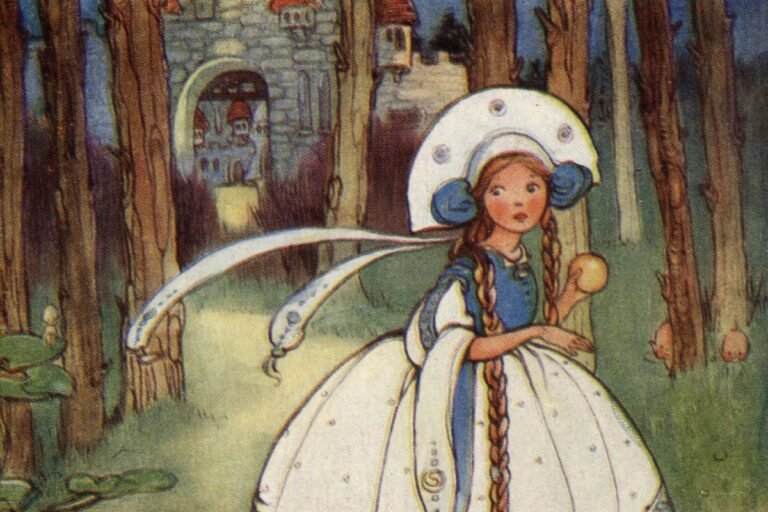
Far away somewhere beyond the Red Sea, there was a certain young lord. When he had grown up in body and mind, he bethought himself that indeed it would not be a bad thing to look round him in the world and seek out a nice wife for himself, and a good mistress for his household. Well, as he determined, so he did. He went out into the world, but could not find such a one as he would have liked. At last he went somehow into the house of a widow, who had three daughters, all maidens. The two elder were as active as wasps for work, but the youngest, who was named Hanka, was like a leaden bird for everything that wanted doing. When the young lord came to them at spinning time he was astounded. ‘How is it,’ thought he, ‘that Hanka can be sleeping in the chimney-corner, while the other spinsters are hard at work at their tasks?’ He said to their mother: ‘But, old lady, tell me, why don’t you make that one, too, take a distaff? She is quite a grown-up girl, and would amuse herself by work.’ ‘Ah! young sir,’ replied the mother, ‘I would allow her to spin with all my heart; I would fill her distaff myself; but what then? She is such a spinster, that by herself she would by morning spin up not only all our spinning materials, but all the thatch from the roof, and that into golden threads; nay, at last she would betake herself to my gray hairs; I am obliged, therefore, to give her a holiday.’ ‘If this be so,’ said the delighted suitor, ‘and if it is God’s will, you can give her to me to wife. You see, I have a nice establishment—flax, hemp, whole heaps of the finer and commoner kinds of tow; she could spin away to her heart’s content.’ At such language the old woman did not take long for consideration, and Hanka woke from her slumbers. They brought the bridegroom expectant a handsome olive-coloured handkerchief out of the clothes-chest, adorned him with periwinkles, and performed the marriage ceremony that very evening. The other spinsters were somewhat mortified at Hanka’s good fortune, but finally were content at it, hoping that they, too, would get rings on their fingers, now that the idle hand, as they nicknamed Hanka, had obtained a husband. The next day our young bridegroom ordered his horses to be harnessed, and when all was ready, placed the tearful bride beside him in a handsome carriage, gave his hand to his mother-in-law, called out ‘Farewell!’ to the bride’s sisters, and they left the village at a gallop.
For better or worse! Poor Hanka sat by her youthful husband mournful and tearful, just as if the chickens had eaten up all her bread. He talked to her enough, but Hanka was as mute as a fish. ‘What’s the matter with you?’ said he. ‘Don’t be frightened. At my house, indeed, there will be no going to sleep for you. I shall give you all that your heart desires. You will have flax, hemp, fine and coarse tow enough for the whole winter, and I have got in a store of apples for spittle.’ But our Hanka became more sorrowful the further they went. Thus they arrived in the evening at the young lord’s castle, got down from the carriage, and, after supper, the future lady was conducted into a large room, in which, from top to bottom, lay nothing but spinning materials. ‘Well,’ said he, ‘here you have distaff, spindle, and spindle-ring, and rosy apples and a few peas for spittle—spin away! If you spin all this, by morning, into golden threads, we shall be man and wife at once; if not, I shall cause you to be put to death without further ado.’ Thereupon the young lord went out and left the spinster to spin. When Hanka was left alone, she didn’t seat herself under the distaff, for she didn’t even know how to twirl the threads, but began sorrowfully to exclaim: ‘Oh God! God! here I am come out to vile disgrace! Why did not my mother teach me to work and spin like my two sisters? I might then have reposed in peace at home; but, as it is, sinful creature that I am, I must perish miserably.’ As she was thus expressing her feelings, the wall suddenly opened, and a little mannikin stood before the terrified Hanka, with a red cap on his head and an apron girt round his waist; before him he pushed a little golden hand-cart. ‘Why have you your eyes so tearful?’ inquired he of Hanka. ‘What has happened to you?’ ‘As if, sinful soul that I am, I should not weep,’ said she; ‘only think, they have ordered me to spin all these spinning materials into golden threads by morning, and if I don’t do so, they will have me put to death without any ceremony. Oh God! God! what shall I do, forlorn in this strange world?’ ‘If that is all,’ said the mannikin, ‘don’t be frightened. I will teach you to spin golden threads cleverly; but only on this condition, that I find you this time next year in this very place. Then, if you do not guess my honourable name, you will become my wife, and I shall convey you away in this cart. But, if you guess it, I shall leave you in peace. But this I tell you: if you choose to hide yourself anywhere this time next year, and if you fly ever so far beneath the sky, I shall find you, and will wring your neck. Well, have you agreed to this?’ It was not, sooth to say, very satisfactory to Hanka; but what could the poor thing do? At length she bethought herself: ‘Let it be left to God, whether I perish this way or that! I agree.’ The mannikin, on hearing this, made three circuits round her with his golden cart, seated himself under the distaff, and repeating:
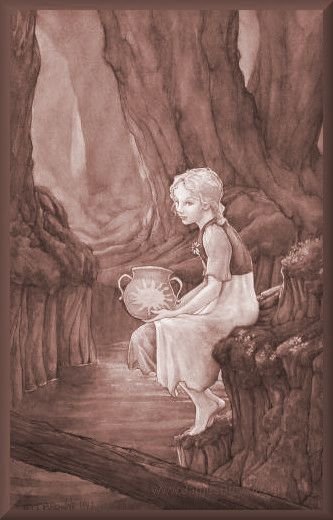
taught and instructed her to spin golden threads. After this, as he came, so he departed, and the wall closed up of itself behind him. Our damsel, from that time forth a real golden spinster, sat under the distaff, and seeing how the spinning materials decreased and the golden threads increased, spun and spun away, and by morning had not only spun up all, but had had a good sleep into the bargain. In the morning, as soon as the young lord awoke, he dressed himself and went to visit the golden spinster. When he entered the room he was all but blinded by the glitter, and wouldn’t even believe his eyes, that it was all gold. But when he had satisfied himself that so it was, he began to embrace the golden spinster, and declared her his true and lawful wife. Thus they lived in the fear of God, and if our young lord had previously loved his Haniczka for the golden spinning, he then loved her a thousand times more for the beautiful son that she in the meantime bore him.
But what? There’s no footpath without an end, neither could the joy of our wedded pair endure for ever. Day passed after day, till finally the appointed time approached within a span. Now our Hanka began to be more sorrowful from moment to moment; her eyes were as red as if they were baked, and she did nothing but creep like a shadow from room to room. And, indeed, it was a serious thing for a young mother to have to lose all at once her good husband and her beautiful son! Hitherto her poor husband knew nought about anything, and comforted his wife as well as he could; but she would not be comforted. When she bethought herself what a nasty dwarf she was going to obtain instead of her shapely husband, she all but dashed herself against the walls from excessive agony. At last she managed to overcome herself, and revealed everything to her husband as it had occurred to her on that first night. He became, from horror, as pale as a whitewashed wall, and caused proclamation to be made throughout the whole district that, if anyone knew of such a dwarf, and should make known his real name, he would give him a piece of gold as large as his head. ‘Ah! what a windfall such a piece of gold as that would be!’ whispered neighbour to neighbour, and they dispersed on all sides, examined all corners, all but looked into the mouseholes, searched and searched as for a needle, but, after all, couldn’t find anything out. Nobody knew and nobody had seen the dwarf, and as for his name, no living soul could guess it. Under such circumstances the last day arrived; nothing had been seen or heard of the mannikin, and our Hanka, with her boy at her breast, was wringing her hands at the prospect of losing her husband. Her unhappy husband, whose eyes were almost exhausted from weeping, in order, at any rate, to escape from beholding the agony of his wife, took his gun on his shoulder, fastened his faithful hounds in a leash, and went out hunting. After hunting time—it was about the hour of afternoon luncheon—it began to lighten on all sides and in all directions, rain poured so that it would have been a shame to turn a dog out into the roads, and in this tempest all our young lord’s servants sought shelter where they could, and got so lost that he remained with only one on a densely wooded unknown hill, and that as soaked and dripping as a rat. Where were they to seek shelter before the ever-increasing storm? where to dry themselves? where to obtain harbour for the night? The unlucky pair, master and servant, looked round on all sides to see whether they couldn’t espy a shepherd’s hut or a cattle-shed; but where nothing is, there is nothing. Finally, when they had almost strained their eyes out of the sockets, they saw where, out of the hole of the side shaft of a mine, puffs of smoke were rolling, as from a limekiln. ‘Go, lad,’ said the young lord to the servant, ‘look whence this smoke issues; there must be people there. Ask them whether they will give us lodging for the night.’ The servant went off and returned in a jiffy with the intelligence that neither door, nor shed, nor people were there. ‘Fie, you’re only a duffer!’ said the lord to his servant with chattering teeth. ‘I’ll go myself; you, for a punishment, shall drip and freeze.’ Well, the noble lord took the job in hand, but neither could he espy anything, save that in one place smoke kept continually issuing out of the side shaft. At last in disgust he said: ‘Whatever devil on devil may bring, know I must whence all this smoke comes.’ So he went to the hole itself, knelt beside it and peeped in. As he was thus peeping, he espied, somewhere under ground, where food was cooking in a kitchen, and covers were laid for two on a stone table. Round this table ran a little mannikin in a red cap with a golden hand-cart before him, and from time to time, after making the circuit, he sang:
And again he ran like mad round the table and shouted:
The young lord wanted nothing more; he ran as fast as his legs could carry him to his servant, and, as it now cleared up a little, they were fortunate enough to find a path, by which they hastened home. He found his wife at home in agony, in misery, streaming with tears; for she thought she would not be able even to take leave of her husband, as he was so long away. ‘Don’t afflict yourself, my wife,’ were the young lord’s first words when he entered the room. ‘I know what you require; his name is Martynko Klyngas.’ And then he, without delay, recounted to her everything, where he had gone and what had happened to him. Hanka could scarcely keep on her feet for joy, embraced and kissed her husband, and betook herself joyfully into the room, in which she had spent the first night, to finish spinning the golden threads. At midnight the wall opened, and the mannikin with the red cap came in, as he had done that time last year, and running round her with the golden cart shouted with the utmost power of his lungs:
‘I’ll have a try to guess,’ said Hanka; ‘your name is Martynko Klyngas.’ As soon as she had uttered this, the little dwarf seized his cart, threw his cap on the ground, and departed as he had come; the wall closed, and Hanka breathed in peace. From that time forth she spun no more gold, and, indeed, neither was it necessary for her so to do for they were rich enough. She and her husband lived happily together, their boy grew like a young tree by the water’s side; and they bought a cow, and on the cow a bell, and here’s an end to the tale I tell.
[This story may be compared with ‘Rumpelstiltskin’ in Grimm. The principle is the same; but, I think, the variation in the details is much in favour of the Slavonic tale.]
📄 Fuente: Sixty Folk-Tales from Exclusively Slavonic Sources
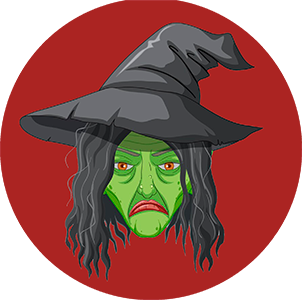
Lejos, más allá del Mar Rojo, vivía un joven señor. Cuando creció en cuerpo y mente, pensó que no estaría mal mirar un poco el mundo y buscar una buena esposa para sí mismo, y una buena señora para su casa. Así que, decidido, salió al mundo, pero no encontró a nadie que realmente le gustara. Finalmente, llegó a la casa de una viuda que tenía tres hijas, todas solteras. Las dos mayores eran tan trabajadoras como avispas, pero la menor, llamada Hanka, era como un pájaro de plomo para todo lo que había que hacer.
Cuando el joven señor las visitó en tiempo de hilado, quedó asombrado. “¿Cómo es posible,” pensó, “que Hanka pueda estar dormida en la esquina de la chimenea mientras las otras están trabajando duro?” Le dijo a la madre: “Pero, señora, dígame, ¿por qué no hace que esa también tome una rueca? Ya es una mujer hecha y derecha, y podría entretenerse con el trabajo.”
“¡Ah, joven señor!” respondió la madre, “con gusto la dejaría hilar, yo misma le llenaría la rueca; pero ¿qué pasaría entonces? Ella es tan hilandera, que por sí sola, antes de la mañana, habría hilado no solo todo nuestro material, sino también todo el techo de paja, ¡y en hilos de oro! Y al final, hasta se llevaría mis cabellos grises; por eso la dejo de descanso.”
“Si es así,” dijo el pretendiente encantado, “y si es la voluntad de Dios, puede dármela por esposa. Verá, tengo una buena casa, lino, cáñamo, y montones de diferentes tipos de estopa fina y común; ella podría hilar a su gusto.”
Con esas palabras, la vieja no tardó en decidirse, y Hanka despertó de su letargo. Sacaron del baúl un bonito pañuelo color oliva, lo adornaron con hierbas y celebraron la boda esa misma noche. Las otras hilanderas quedaron algo molestas por la suerte de Hanka, pero al final se conformaron, esperando que también ellas pronto tuvieran anillos en sus dedos, ahora que la “mano ociosa,” como apodaban a Hanka, había conseguido marido.
Al día siguiente, el joven esposo mandó preparar los caballos y, cuando todo estuvo listo, colocó a la llorosa novia a su lado en un hermoso carruaje, le ofreció la mano a su suegra, dijo “¡Adiós!” a las hermanas de la novia, y partieron al galope.
“¡Para bien o para mal!” La pobre Hanka se sentó junto a su joven esposo, triste y llorosa, como si los pollos le hubieran comido todo el pan. Él le habló bastante, pero Hanka estaba muda como un pez.
“¿Qué te pasa?” le preguntó. “No tengas miedo. En mi casa no habrá tiempo para dormir. Te daré todo lo que tu corazón desee. Tendrás lino, cáñamo, estopa fina y gruesa para todo el invierno, y he almacenado manzanas para escupir mientras hiles.” Pero Hanka se ponía más triste cuanto más avanzaban.
Así llegaron al anochecer al castillo del joven señor, bajaron del carruaje, y después de cenar, llevaron a la futura señora a una gran habitación que estaba, de arriba a abajo, llena solo de materiales para hilar.
“Bien,” dijo él, “aquí tienes rueca, huso y anillo de huso, y manzanas rosadas y unos pocos guisantes para escupir, ¡a hilar! Si para la mañana hileras todo esto en hilos de oro, seremos marido y mujer; si no, te haré matar sin más trámite.”
Entonces el joven señor salió y dejó a Hanka a solas con la tarea. Pero ella no se sentó bajo la rueca porque ni siquiera sabía cómo hacer girar los hilos, sino que comenzó a lamentarse: “¡Oh Dios! ¡Dios! ¡Aquí he venido a una vil desgracia! ¿Por qué mi madre no me enseñó a trabajar y a hilar como mis dos hermanas? Entonces podría haber descansado en paz en casa; pero, como soy un alma pecadora, debo morir miserablemente.”
Mientras se lamentaba, la pared se abrió de repente, y apareció un pequeño hombrecito con un gorro rojo y un delantal alrededor de la cintura; delante de él empujaba un pequeño carrito dorado.
“¿Por qué tienes los ojos tan llorosos?” le preguntó a Hanka. “¿Qué te ha pasado?”
“¿Como si yo, alma pecadora, no tuviera motivo para llorar?” dijo ella; “¡Imagínate, me han ordenado hilar todos estos materiales en hilos de oro para la mañana, y si no lo hago, me matarán sin ceremonia! ¡Oh Dios! ¡Dios! ¿Qué haré, perdida en este mundo extraño?”
“Si eso es todo,” dijo el hombrecito, “no temas. Te enseñaré a hilar hilos de oro con destreza, pero solo bajo esta condición: que el próximo año por estas fechas te encuentre en este mismo lugar. Si para entonces no adivinas mi honorable nombre, serás mi esposa y te llevaré en este carrito. Pero si lo adivinas, te dejaré en paz. Pero te advierto: si eliges esconderte en cualquier lugar o volar lejos bajo el cielo, te encontraré y te estrangularé. ¿Estás de acuerdo?”
No era, para ser sincera, muy satisfactorio para Hanka, pero ¿qué podía hacer la pobre? Finalmente pensó: “Que sea la voluntad de Dios, sea que muera de una manera u otra. Estoy de acuerdo.”
Al oír esto, el hombrecito dio tres vueltas alrededor de ella con su carrito dorado, se sentó bajo la rueca y repitió:
—Así, Haniczka, así,
Así, Haniczka, así,
Así, Haniczka, así—
le enseñó a hilar hilos de oro. Después de esto, tal como llegó, así se fue, y la pared se cerró sola tras él. Nuestra doncella, desde ese momento convertida en una verdadera hilandera de oro, se sentó bajo la rueca, y al ver cómo el material para hilar disminuía y los hilos de oro aumentaban, hiló y hiló, y para la mañana no solo había hilado todo, sino que también había dormido bien.
Al amanecer, tan pronto como el joven señor despertó, se vistió y fue a visitar a la hilandera de oro. Al entrar en la habitación, casi quedó cegado por el brillo y no quería creer lo que veían sus ojos: todo era oro. Pero cuando se aseguró de que era verdad, abrazó a la hilandera de oro y la declaró su esposa legítima. Así vivieron en el temor de Dios, y si antes el joven señor amaba a su Haniczka por su habilidad para hilar oro, entonces la amó mil veces más por el hermoso hijo que ella le había dado.
Pero, ¿qué? No hay camino sin final, y tampoco la alegría de la pareja casada podía durar para siempre. Pasó un día tras otro, hasta que finalmente se acercó el día señalado.
Nuestra Hanka se fue poniendo cada vez más triste; sus ojos estaban tan rojos como si los hubieran horneado, y no hacía más que deslizarse de sombra de una habitación a otra. Y, de hecho, era algo muy grave para una joven madre tener que perder de golpe a su buen esposo y a su hermoso hijo. Hasta entonces, su pobre marido no sabía nada y la consolaba lo mejor que podía, pero ella no quería consuelo.
Cuando pensaba en el horrible enanito que iba a recibir en lugar de su apuesto esposo, casi se estrellaba contra las paredes por el dolor. Finalmente logró dominarse y le contó todo a su marido, tal como le había sucedido aquella primera noche.
Él, de horror, palideció como una pared encalada y mandó hacer un anuncio por todo el distrito: quien supiera algo del enanito y diera a conocer su nombre verdadero recibiría una pieza de oro tan grande como su cabeza.
—¡Ah! ¡Qué fortuna sería una pieza de oro así! —susurraban los vecinos unos a otros, y se dispersaron por todas partes, inspeccionaron cada rincón, casi miraron hasta en los agujeros de ratones, buscaron y buscaron como si fuera una aguja, pero no encontraron nada. Nadie sabía ni había visto al enanito, y en cuanto a su nombre, ningún alma viva podía adivinarlo.
Así llegó el último día; no se había visto ni oído nada del hombrecito, y nuestra Hanka, con su niño al pecho, se retorcía las manos al pensar que perdería a su esposo.
Su desdichado marido, cuyos ojos casi se habían agotado de tanto llorar, para escapar al menos de ver la agonía de su esposa, tomó su rifle, puso a sus fieles perros con correa y salió de cacería.
Después de un rato, cuando ya era hora del almuerzo, comenzó a aclarar por todas partes y a llover tan fuerte que habría sido una vergüenza sacar a un perro a la calle.
En medio de esta tormenta, todos los sirvientes del joven señor buscaron refugio donde pudieron, y él quedó solo con uno en una colina boscosa desconocida, ambos empapados como ratas.
¿Dónde podrían buscar refugio antes de la tormenta creciente? ¿Dónde secarse? ¿Dónde pasar la noche?
Los dos, amo y criado, miraron por todas partes para ver si podían encontrar una choza de pastor o un establo; pero donde no hay nada, no hay nada.
Finalmente, cuando casi se habían quedado sin vista de tanto buscar, vieron que por un agujero lateral de una mina salía humo, como de un horno de cal.
—Ve tú, muchacho —dijo el joven señor a su criado—, mira de dónde sale ese humo; debe haber gente allí. Pregúntales si nos darán alojamiento para la noche.
El criado fue y volvió en un instante con la noticia de que no había puerta, ni cobertizo, ni gente.
—¡Bah! —dijo el señor con los dientes castañeando—, ¡eres un tonto! Yo iré yo mismo; tú, como castigo, te mojarás y pasarás frío.
El noble señor tomó la iniciativa, pero no pudo ver nada, salvo que por un lugar el humo salía continuamente del pozo lateral.
Finalmente, con disgusto, dijo:
—Sea lo que sea, debo saber de dónde viene todo ese humo.
Se acercó al agujero, se arrodilló y miró dentro.
Al hacerlo, vio bajo tierra, donde se cocinaba comida en una cocina, y una mesa de piedra puesta para dos.
Alrededor de esa mesa corría un pequeño hombrecito con gorro rojo y un carrito dorado delante, y de vez en cuando, tras dar la vuelta, cantaba:
“He fabricado una hilandera de oro para el joven señor,
Esta noche intentará adivinar mi nombre;
Si adivina bien, la dejaré en paz;
Si no lo hace, me la llevaré:
Mi nombre es Martynko Klyngas.”
Y otra vez corría como loco alrededor de la mesa y gritaba:
“Estoy preparando nueve platos para la cena,
La colocaré en una cama de seda;
Si adivina,” etc.
El joven señor no quiso nada más; corrió tan rápido como sus piernas se lo permitían hacia su criado y, como el cielo ya se había despejado un poco, tuvieron la suerte de encontrar un camino por el que se apresuraron a volver a casa.
Al llegar, encontró a su esposa en casa, llena de agonía y miseria, llorando a mares, pues pensaba que ni siquiera podría despedirse de su esposo, que llevaba tanto tiempo fuera.
—No te aflijas, esposa mía —fueron las primeras palabras del joven señor al entrar en la habitación—. Sé lo que necesitas; su nombre es Martynko Klyngas.
Y sin demora le contó todo: a dónde había ido y lo que le había sucedido.
Hanka apenas pudo mantenerse en pie de la alegría, abrazó y besó a su esposo, y se dirigió contenta a la habitación donde había pasado su primera noche para terminar de hilar los hilos de oro.
A medianoche la pared se abrió, y el hombrecito con el gorro rojo entró, como había hecho aquel mismo día el año anterior, y corriendo alrededor de ella con el carrito dorado gritó con todas sus fuerzas:
—Si adivinas mi nombre, te dejo;
Si no lo adivinas, te llevo conmigo;
¡Solo adivina, adivina ya!
—Voy a intentarlo —dijo Hanka—; tu nombre es Martynko Klyngas.
En cuanto pronunció esto, el pequeño enano tomó su carrito, lanzó su gorro al suelo y se fue tal como había llegado; la pared se cerró, y Hanka respiró aliviada.
Desde ese momento ya no hiló más oro, y de hecho no fue necesario, porque tenían suficiente riqueza.
Ella y su esposo vivieron felices juntos, su niño creció como un joven árbol junto al agua; compraron una vaca, y a la vaca un cencerro, y así termina el cuento que os he contado.
Cuento popular de Hungría, recopilado por A. H. Wratislaw en Sixty Folk-Tales from Exclusively Slavonic Sources, en 1890
Versión eslava del cuento Rupelstiltskin