 Cuentos con magia
 Leyendas y Mitos
Ver transcripción original
LII.—KRALJEVITCH MARKO.
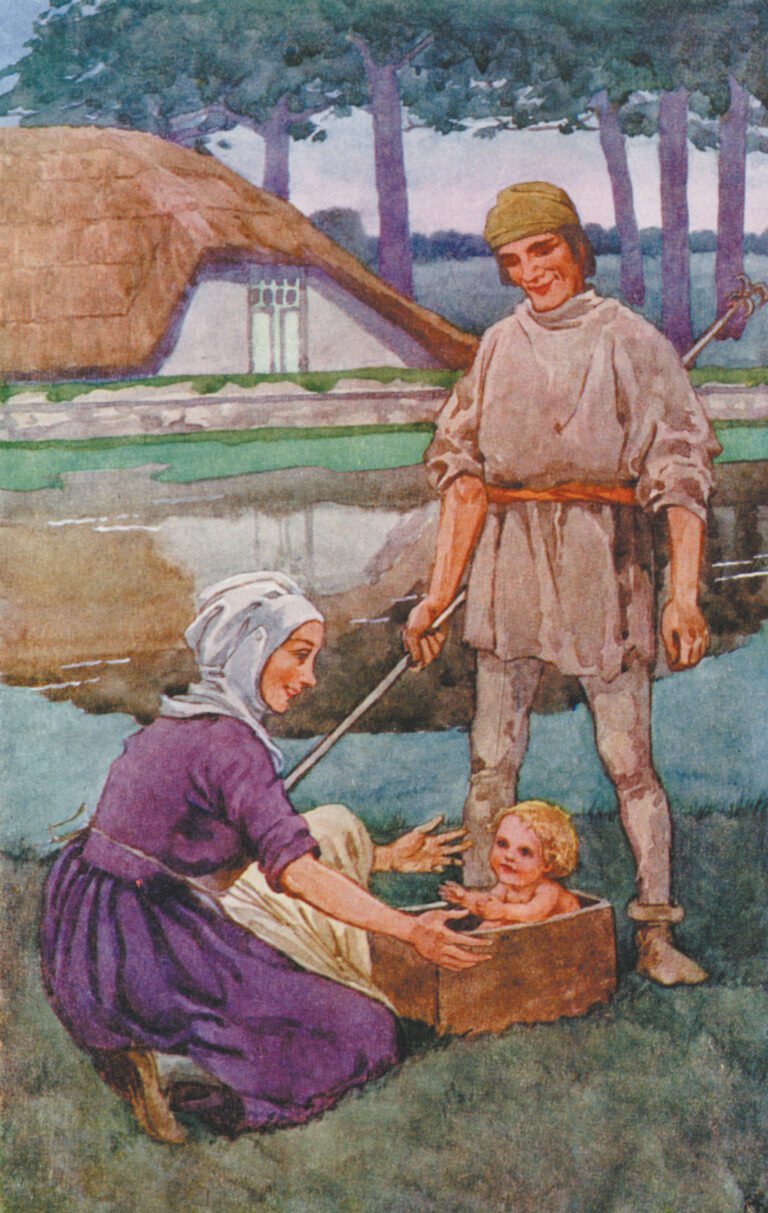
There was once upon a time a mother who gave birth to Kraljevitch Marko. She reared him, and placed him in a position to become a hero. When Marko was growing up he was obliged to feed swine, but he was then weakly, and so dwarfish a lad that his comrades were able to beat him, and wanted him to be a sort of servant for them and tend their swine. But he was not willing to do this, so they beat him and lugged him by the hair, so that he was obliged to run away from them. He got away, and went into the fields, and there roamed about, thinking: ‘They would be beating me all day, now one, now another of them; but as it is, when I go to them in the evening, they will only beat me once.’ As he roamed about, he came up to a baby. He saw that it was a handsome one, and that it was lying in the sun. He made it a cool shade with branches, and went a little way off and sat down. As he thus sat, up came a Vila, and said to herself: ‘Gracious God! who has done this? Let him ask me for anything in the world; I will give it him.’ He heard this, approached, and said: ‘Sister, I have done this for you.’ ‘You have done it, little brother? Come! what do you ask of me in return, that I may reward you for being so good as to make a cool shade for my baby?’ ‘Ah, dear sister! what I should ask you, you could not give me.’ ‘Well, what is such a mighty matter? only tell me.’ He was thinking of this, that his comrades might not beat him at the pasture; therefore he said that he should wish that they should not beat him. She replied: ‘Well, if that is what you wish for, come and suck my breast.’ He obeyed her, went and sucked. When he had finished sucking, the Vila said to him: ‘Well, go now and heave yon stone, and try whether you can heave it up.’ The stone was twelve hundredweight. He went to heave it, but could not stir it from its place. Then the Vila said to him: ‘Come and suck again; when you have done sucking, go and heave it.’ He went to suck, and when he had finished, went to heave it, but only lifted it a little. Then he went again to suck, with such effect that he could already cast it a little way. He went to suck once more. Then he was already able to cast it to a great height and over hills, so that it was no more to be found. Once more she bade him come to suck. He sucked his fill, and then she said to him: ‘Go now whithersoever you will; no one will beat you any more—no, not your comrades.’ He went merrily to the herdsmen, and they called to him: ‘Where have you been that we are obliged to tend your swine?’ and rushed upon him to beat him. He only waited for them. When they came up to him, he seized one, knocked them down, and the one who was in his hands was quite squashed, with such force had he taken hold of him. The other shepherds, who saw what he did, ran to the home of those whom he had knocked down, saying: ‘Marko has knocked down your son, and so-and-so’s, and so-and-so’s.’ They all went to his mother: ‘What manner of son is this that you have reared up?—a brigand, who kills our children!’ She was terrified out of her wits, thinking what her son had done. She began to revile him: ‘Sonny, never did my eye see that you did anything; wherefore do you thus to me, that other people come to revile me because of your doings? Go! I shall be glad if my eye never sees you more. Why do you put me to shame?’ ‘Well, then, good! if so you say, I will go into the world.’ ‘Only go that I may never see you.’ ‘Well, then, good! go I will.’
He went. Now, he thought to himself: ‘What shall I do? I am a hero, but I have not what a hero requires.’ Then he went to a smith, at whose smithy were five-and-twenty smiths. ‘God help you, smith!’ ‘God help you, Kraljevitch Marko! why have you come to me?’ ‘I have come to you that you may forge me a sword weighing twelve hundredweight; then you shall also forge me a mace, if you make the sword well; but you must know that it must be stronger than your anvil. If it cuts it through, you shall receive payment; otherwise, not. Have you understood me?’ ‘Yes.’ ‘Well, then make it now.’ All five-and-twenty smiths went immediately and forged the sword. When it was ready, Marko came. ‘Well, smith, have you got it ready?’ ‘Yes, Marko.’ ‘Now come, let me see.’ Marko struck, but the sword broke into two pieces, and not the anvil. ‘Ah! friend smith, you’ve not done it well; you get no pay.’ He went on to another smith. ‘God help you, smith!’ ‘God help you, Kraljevitch Marko! What work do you want done?’ ‘I have come to you to make me a sword weighing twelve hundredweight, and to make it stronger than your anvil, because, if it cuts through your anvil, you will receive payment; if not, you will get nothing. Have you understood me?’ ‘Yes.’ ‘Then make it.’ Then up came the thirty smiths, worked at the sword, and worked until they had finished forging it. Marko came: ‘Well, smith, is the sword ready?’ ‘It is, Marko.’ ‘Show it me that I may see it.’ Marko took it, struck, cut through the anvil, and cut right into the block. ‘Well, smith, you’ve made it well. Now that you’ve made me a sword, make me also a sheath for the sword, and also a club, that is, a mace, weighing twelve hundredweight, then I will pay you all at once. But when I throw the mace, it must not break; if it breaks, then you get no payment.’ He made him a mace also, but did not make it well. When Marko threw it, he let it fall upon himself, and the mace broke. Then said Marko: ‘You have made me the sword well, but not the mace. Reach out your hand that I may pay you for the sword.’ The smith reached out his hand, and Marko cut it off with the sword, saying: ‘There’s your payment, smith, for the sword, that you may no more make such swords for any hero.’ Then he went to a third smith, with whom thirty-eight smiths were at work, and said: ‘God help you, smith!’ ‘God requite you, Marko! why have you come to me?’ ‘I have come to you to make me a club, that is, a mace, weighing twelve hundredweight; I tell you the truth, if I throw it up on high, and it breaks when it falls, you get no payment.’ All thirty-eight smiths worked till they forged it. Marko came: ‘Well, is the mace ready?’ ‘It is, Marko.’ ‘Show it, that I may see it.’ When he gave it him, he threw it so high into the air that it was three days and three nights in the sky. When it came down, Marko presented his back; it fell upon him, and cast him to the ground, and blood flowed from his nose and teeth, but the mace remained sound. But Marko sprang up quickly, and said to the smith: ‘Ah! dear smith! you’ve made it well for me; reach out your hand that I may pay you.’ He reached out his hand to him, and he cut his hand off with his sword. ‘Let this be your payment, smith, that you may no more make such staves for any hero.’
Then he went off to his mother and said to her: ‘Mother, you see in me a hero; if you revile me, I shall go about the world.’ Then his mother began to scold him: ‘Why are you like this? Why don’t you live like other people? You have oxen; go, then, on to the green hill and plough the fallows and pastures, and thereby support your old mother.’ Marko obeyed her, took the oxen, and went. But he didn’t go on to the green hill, to plough the fallows and pastures, but he went and ploughed the emperor’s highroads. When the Turks saw this, they went to Marko—three hundred Turks, all chosen warriors—and said to him: ‘Why, Marko, do you plough the emperor’s highroads? you have the fallows and pastures!’ Then at him, to cut him down. When Marko saw this, he hadn’t with him either his sword or his mace, so seized his plough and felled all three hundred Turks. Then said he: ‘Ah! gracious God! a wondrous hero!’ Then he took the Turks’ gold from them, left his plough, unyoked the oxen, and turned them loose on the green hill: ‘Go, little oxen, on to the green hill, and feed and graze from pine to pine, like the cuckoo; Marko has not managed to plough with you, and now never will he more.’ And home he went singing: ‘Here, mother, you have gold enough, live upon it, and I will go into the world, that your eye may see me no more.’
He took his mace and sword, went and came to an inn, where some Turks were drinking red wine and conversing. ‘We should be glad to make the acquaintance of Kraljevitch Marko and see him. We have heard that he is a celebrated hero. His brother Andro is in Stambol here. He is a hero, but they say that he is a still greater hero.’ ‘In whose service is Andro Kraljevitch?’ ‘In that of a pasha; he will soon come riding past here.’ ‘Good; I will wait for him.’ Up came Andro Kraljevitch, riding with the pasha. Marko called out to him: ‘Eh, adopted brother, Kraljevitch Andro!’ ‘Thanks, unknown hero, perhaps you are Kraljevitch Marko?’ ‘Quite true, I am Kraljevitch Marko.’ ‘Good; let us go into the inn to drink a cup of wine, that love and the fortune of heroes may thus unite us. Now we are not afraid of going into combat against any empire.’ So they went on the way to an inn. Kraljevitch Marko said: ‘Prithee, sing me a song, Andro.’ ‘Dear brother, I dare not. The Vila of the cloud would shoot me.’ ‘Don’t be afraid; I am here.’ Andro obeyed, and sang so that all the branches began to fall. All at once a spear flew against Andro and struck him down. Marko looked about to see whence it came, and espied a Vila in the cloud; he seized his mace and threw it at the Vila, so that it at once struck her to the ground. The Vila began to shriek: ‘Let me go, Marko! I will bring Andro back to life, and will give you a wondrous horse, so that you will be able to fly in the air.’ Marko agreed, and she took certain grasses, and brought Andro back to life. Marko obtained the wondrous horse, and both rode off to an inn and drank red wine. But in the inn there was a wicked harlot. She became enamoured of Andro, but he would not even look at her. She therefore put sweet honey into his wine, that he might drink the wine. Marko went out for a short time, and the wicked woman murdered Andro. But when Marko came in he seized the wicked woman, and spitted her on his sword: ‘Take that, wretch, for murdering my brother Andro.’
He went on into the world. He roamed hither and thither, and when he met with any hero, he tried the fortune of combat with him, as in his encounter with black Arapin. Arapin built a tower beside the level sea. When he had built it handsomely and raised it high, he said thus to it: ‘Handsomely, my tower, handsomely have I built thee, and high have I raised thee, for I have no father nor mother, no brother nor sister, nor even my beloved, to walk about in thee. But I have a love, the daughter of the emperor Soliman. I will write him the leaf of a white book, and send up to him by a black Tatar; for if he will not give her to me, let him meet me in single combat.’ He wrote the leaf of a white book and sent it by a black Tatar. When Soliman read over the leaf of the white book, he shed tears abundantly, and his empress Solimanitza came to him and questioned him: ‘Why do you weep, emperor Soliman? Ofttimes have letters come for you, and you have not shed abundant tears; what distress is tormenting you?’ He told her this, that black Arapin had written to him, that, if he did not give him his daughter, he must meet him in single combat; and how could he meet him in single combat? She advised him to write the leaf of a white book to Kraljevitch Marko to come, promising to give him three loads of money. He wrote the leaf of a white book and sent it by a black Tatar. When Kraljevitch Marko read over the leaf of the book, he began to laugh greatly: ‘Yes, i’ faith, emperor Soliman! what will your money do for me, if black Arapin severs my head from my shoulders?’ And he said not whether he would go or not go. The emperor Soliman was anxiously expecting the Tatar, who brought to him the words, that Marko neither said that he would come, nor that he would not come. Thereupon the emperor was sorrowful, for he had no such man who would deliver his daughter. There arrived a second letter from black Arapin, that he must give him his daughter; if he did not give her, he must meet him in single combat. As he read it, he shed abundant tears. Thereupon his only daughter came to him and asked him: ‘Why do you weep, emperor Soliman? Letters have ofttimes arrived for you, and you have not shed abundant tears.’ He replied to her: ‘Dear daughter! You see that black Arapin writes to me, that, if I do not give you to him, I must meet him in single combat; and how shall I, poor man that I am, meet him?’ ‘You know, dear father, that there is one hero, Kraljevitch Marko. Write to him, that you will give him nine loads of money, if he will come and meet him in single combat.’ The emperor Soliman wrote to Kraljevitch Marko the leaf of a white book, and sent it to him by a black Tatar. When he read over the leaf of the white book he laughed greatly: ‘I’ faith, emperor Soliman! what will your money be to me, if black Arapin severs my head from my shoulders?’ Thereupon he did not say whether he would come or not come. Sorrowful thereat, the emperor did not know what to do. Then came a third letter from black Arapin, that he was coming, and that he must prepare, would he, nould he, to give him his daughter, and that all inns and shops must be shut for fear of him. Thereupon the emperor Soliman shed abundant tears as he read it. His daughter came to him: ‘Why do you weep, emperor Soliman? Letters have ofttimes arrived for you, and you have not shed abundant tears. What distress is assailing you?’ ‘You see, dear daughter, that black Arapin writes to me, that if I don’t give you to him, I must meet him in single combat! But how shall I, poor man, meet him?’ ‘Write, dear father, to Kraljevitch Marko to come, and offer him twelve loads of money, and a shirt which is neither spun nor woven nor bleached, but made of nothing but pure gold, and a serpent that holds a tray in its mouth, and on the tray a golden casket, and in the casket a precious stone, by aid of which you can sup at midnight just as well as at mid-day.’ He wrote the leaf of a white book and sent it to Kraljevitch Marko by a black Tatar, and offered him all that his daughter told him. When Marko read the leaf of the white book, he laughed greatly, and said: ‘I’ faith, emperor Soliman! what will your money do for me, if black Arapin severs my head from my shoulders?’ And then, too, he did not say that he would come or not come. Thereupon came the leaf of a white book from black Arapin, that Arapin had now got ready three hundred heroes, all in silver armour, and all chosen warriors. Then said Kraljevitch Marko to his piebald horse: ‘Eh! piebald horse, my pearl! you know well that you must be faithful to me, for, if not, I shall cut off your feet at the knees, and that you must bear yourself valiantly.’ And the piebald horse replied that he must saddle and mount with speed to go soon, and that black Arapin was already near. Marko saddled and mounted him, and went to the city where the emperor Soliman reigned.
Now, when he had ascertained by which road Arapin’s men were coming, he presented himself to a young innkeeper, and said, knocking at the door: ‘Open, and bring some wine.’ But he excused himself, saying that he dared not draw any, for all inns and shops were obliged to be shut for fear of black Arapin. But the hero said to him: ‘You must bring some for me, or I shall cleave your head to the shoulders.’ The innkeeper saw that it could not be otherwise, and was obliged to bring him a cup of wine. Marko drank half, and gave half to his piebald horse. Then he brought two cups, one for Marko, and one for the horse. Meanwhile, Marko went into the garden to look about him. When he got there, he saw by the side of a brook a damsel in sorrow, and wondered what ailed her that she wept so piteously, saying: ‘Ah! my rivulet! I would rather abide in you, than lie behind black Arapin’s back.’ When Marko saw that it was Soliman’s daughter, he said: ‘What ails you, damsel, that you weep so piteously?’ She replied to him: ‘Go hence, unknown hero! As to what you ask me, you cannot aid me.’ ‘Now, only tell me; maybe I shall aid you.’ ‘Black Arapin will come, and will take me away from my father and mother; but I had a man, who could have set me free, but he will not. I offered him twelve loads of money, and a shirt, which is neither spun nor bleached, but is made of pure gold; and a serpent, that holds in its mouth a tray, and on the tray a golden casket, and in the casket a precious stone, by aid of which he could sup at midnight, as well as at mid-day; but he won’t. The sun has not seen him, neither has the moon thrown its light upon him, nor has he seen his mother more, nor has a bird sung to him.’ Marko answered her: ‘Don’t chatter, don’t chatter; but go and say that I have arrived. I am Marko; and let him dress and furnish you handsomely, and give you all that is requisite for Arapin, and all that he shall desire.’ Then she ran to her father, and told him all that Marko said. Meanwhile, while Marko was conversing with the damsel, Arapin arrived, saw an inn open, and a horse in front of it standing tethered at the entrance. He said: ‘Who is this, that is not afraid of my terror?’ And thereupon he said that he would soon teach him to be afraid of him. After this, he shouted an order to the bedelija; the bedelija (such is the [Turkish] name for a horse) would not stir. ‘Well, I’ll go thither; I won’t make quarrels; maybe I shall obtain possession of the damsel without any disturbance.’ And, in fact, thither he went, obtained possession of the damsel, and all that he needed was given him. Then he went again to the inn, and saw the horse again standing there. Again he was about to go to the innkeeper to slay him; but he shouted to the horse, the horse wouldn’t stir. Said Arapin: ‘Well, I won’t make quarrels, now that I have obtained the damsel without any quarrel.’ When Arapin proceeded on his way, Marko came out of the garden, and his piebald horse said to him: ‘Where have you been so long, that Arapin might easily have killed me?’ ‘Now don’t fear, my piebald; we shall soon kill him, please God, not he you.’ Then he called for one more cup of wine for himself, and one for his piebald. When they had finished drinking, they started on their way, and in pursuit of Arapin. Arapin had already told his chief officer to look round to see whether any dark fog came out behind them. He looked round, but saw nothing. But when he afterwards looked round a second time, he espied a dark fog, and said to Arapin: ‘Yes, my lord, a dark foul fog is coming behind [276]us.’ Scarcely had he said this, when Marko attacked, and began to slaughter, his rearguard. Arapin said to him: ‘Don’t be silly, Marko; why are you playing the fool with us? I don’t know whether you are jesting, or playing the fool.’ ‘I am neither jesting nor playing the fool, but am in earnest.’ ‘Do, then, what you can; throw what you have.’ ‘I won’t; but throw you your mace.’ Marko’s piebald threw himself down, and Arapin’s mace went over Marko’s head. Then Marko threw his mace, and felled Arapin to the ground, and the piebald leapt to Arapin, and said to Marko: ‘Come, see that you cut off Arapin’s head.’ When the piebald leapt, Marko, too, struck with his sword, and cut off Arapin’s head, and the piebald quickly leapt backwards thirty paces. Then he left Arapin’s carcase on the ground, gave the head to the damsel, and said: ‘Kiss him, now that he is dead, though you wouldn’t when he was living.’ They went home, and the emperor caused a great entertainment to be prepared, and all Marko’s friends, and his father and mother, to be invited, and Marko obtained his promised reward.
So, too, he tried the fortune of combat with Musa Urbanusa.[19] He had three hearts. Marko fought with him for three nights and three white days without cessation, so that red foam already issued from Marko, while not even white foam came from Musa Urbanusa. Then Kraljevitch Marko shouted: ‘Eh! sister Vila!’ The Vila replied: ‘I cannot help you, because the baby has fallen asleep in my arms; but don’t you know your secret weapon?’ Then said Kraljevitch Marko: ‘Look, Musa Urbanusa, whether the sun is now rising or setting.’ Musa looked at the sun, and Marko drew his knife, and ripped Musa up. Musa seized hold of him so powerfully that he barely dug his way out from under Musa, whom he had ripped up. There he [277]lay, and Marko pushed himself sideways, and when he had extricated himself, went to look what there was in this man that was so strong. He saw that Musa had three hearts, one was beating, the second was beginning to beat a little, and the third did not yet know aught about it. On the third he saw a snake lying, and the snake said to Marko: ‘Thank God that I didn’t know of it; you wouldn’t have done what you have done. But open your mouth, Marko, that I may enter into you, that you, too, may be as strong as he was.’ Marko became angry, and cut the snake to pieces, saying: ‘I don’t need such a foul creature as you are.’
[19] Musa, the Albanian, more properly Arbanasian.
Then he proceeded on his way, and went about till firearms were invented. He went up to a shepherd, who was shooting birds. Then Marko asked him: ‘What’s this that you are doing?’ ‘Eh! you see, I’m shooting birds; and I could shoot you, also.’ ‘And how would you kill me with this thing? Heroes have not killed me; could you do so?’ Then he reached his hand to him, and said: ‘Shoot into my hand here.’ He shot, and shot through his hand. Then said Marko: ‘It is not worth my while to live any longer in the world; now any cuckoo could slay me; I had rather quit it.’ He went into a cavern, and lives there still at the present day. Into this cavern a man was compelled to go, who was let down by a rope in a chest. When he arrived within, the Vila immediately stepped up to him, and said: ‘Christian soul, why come you here?’ He told her why and how. But Marko heard that somebody was conversing, and immediately asked the Vila who it was that had come in. She told him that a soul from that world had come to see what was in the cavern. Marko immediately said that he must come to him, that he might see how strong people in the world still were, and he must give him his hand. But she gave him a red-hot iron, and Marko took it, and squeezed it in his hands so that water spirted out of it, and said: ‘Ah, ah! I could still live in the world if no one would talk about me for three days.’ He also commissioned him to tell the lords that he should come there. He gave him a letter, too, and sealed it with his own hand, and allowed him to go up. He shook the rope, and got into the chest. Then they pulled him up, and he gave the letter to the lords; but, for fear of Marko’s coming, the lords did not make the letter public for people to know how Marko had gone into the cavern. The footprints of his horse are still recognised.
📄 Fuente: Sixty Folk-Tales from Exclusively Slavonic Sources


Había una vez una madre que dio a luz a Kraljévich Marko. Lo crió y lo puso en condiciones de convertirse en un héroe. Cuando Marko estaba creciendo, tuvo que cuidar cerdos, pero entonces era un niño débil y tan enclenque que sus compañeros podían pegarle, y querían que fuera como un sirviente para ellos, cuidando sus cerdos. Pero él no estaba dispuesto a hacerlo, así que lo golpeaban y le tiraban del pelo, por lo que tuvo que huir de ellos.
Se escapó y se fue al campo, vagando mientras pensaba:
—Me estarían pegando todo el día, ahora uno, luego otro; pero así como estoy, cuando vaya por la tarde, solo me golpearán una vez.
Mientras deambulaba, se encontró con un bebé. Vio que era hermoso y que estaba acostado al sol. Le hizo una sombra fresca con ramas y se sentó un poco más allá. Mientras estaba así sentado, llegó una Vila y dijo para sí:
—¡Dios mío! ¿Quién ha hecho esto? Que me pida lo que quiera en el mundo, se lo daré.
Él la oyó, se acercó y dijo:
—Hermana, yo lo hice por ti.
—¿Tú lo hiciste, hermanito? ¡Ven! ¿Qué me pides a cambio, para que te recompense por haber hecho una sombra fresca para mi hijo?
—Ah, querida hermana… lo que debería pedirte no podrías dármelo.
—¿Y qué es tan importante? Solo dímelo.
Él pensaba que no quería que sus compañeros lo golpearan más en el pasto, así que dijo que deseaba que no lo golpearan.
Ella respondió:
—Bueno, si eso es lo que deseas, ven y chupa de mi pecho.
Él obedeció, fue y chupó. Cuando terminó, la Vila le dijo:
—Bien, ahora ve e intenta levantar esa piedra, y mira si puedes moverla.
La piedra pesaba seiscientas arrobas (alrededor de 600 kg). Fue a levantarla, pero no pudo moverla. Entonces la Vila dijo:
—Ven y chupa otra vez; cuando termines, vuelve a intentarlo.
Fue a chupar y, cuando terminó, pudo levantarla un poco. Luego volvió a chupar, y ya pudo lanzarla a una corta distancia. Chupó una vez más. Entonces ya podía lanzarla a gran altura y por encima de las colinas, de modo que ya no se volvió a encontrar. Una vez más ella le pidió que chupara. Él chupó hasta saciarse, y entonces ella le dijo:
—Ahora ve donde quieras; nadie volverá a golpearte, ni siquiera tus compañeros.
Fue alegre con los pastores, y ellos le gritaron:
—¿Dónde has estado, que tenemos que cuidar tus cerdos?
Y corrieron hacia él para golpearlo. Pero él los esperó. Cuando se acercaron, agarró a uno, lo tumbó, y el que tenía en sus manos quedó completamente aplastado, de la fuerza con que lo tomó. Los otros pastores, al ver lo que hizo, corrieron a casa de los golpeados diciendo:
—Marko ha tumbado a tu hijo, y al de fulano, y al de mengano.
Todos fueron a casa de su madre:
—¿Qué clase de hijo has criado? ¡Un bandido que mata a nuestros hijos!
Ella se asustó mucho, pensando en lo que había hecho su hijo. Empezó a regañarlo:
—Hijo mío, nunca vi que hicieras algo como esto; ¿por qué me haces esto, que la gente venga a reprocharme por tus acciones? ¡Vete! Me alegrará no verte nunca más. ¿Por qué me avergüenzas así?
—Bueno, pues, si así lo dices, me iré por el mundo.
—Solo vete, para no verte más.
—Está bien, me iré.
Se fue. Entonces pensó:
—¿Qué haré? Soy un héroe, pero no tengo lo que necesita un héroe.
Fue entonces a una herrería donde trabajaban veinticinco herreros.
—¡Dios te ayude, herrero!
—¡Dios te ayude, Kraljévich Marko! ¿Por qué has venido?
—He venido para que me forjes una espada de seiscientas arrobas; luego también me forjarás una maza, si haces bien la espada. Pero debes saber que debe ser más fuerte que tu yunque. Si la espada lo corta, recibirás el pago; si no, no recibirás nada. ¿Lo has entendido?
—Sí.
—Entonces hazla.
Los veinticinco herreros se pusieron de inmediato a forjar la espada. Cuando estuvo lista, vino Marko.
—Bueno, herrero, ¿está lista?
—Sí, Marko.
—A ver, déjame verla.
Marko golpeó, pero la espada se partió en dos y no cortó el yunque.
—¡Ah, amigo herrero, no la hiciste bien! No recibes pago.
Fue a otro herrero.
—¡Dios te ayude, herrero!
—¡Dios te bendiga, Kraljévich Marko! ¿Qué trabajo necesitas?
—He venido para que me hagas una espada de seiscientas arrobas, y que sea más fuerte que tu yunque, porque si corta el yunque, recibirás pago; si no, nada. ¿Lo has entendido?
—Sí.
—Pues hazla.
Entonces treinta herreros se pusieron a trabajar y forjaron la espada. Marko llegó:
—Bueno, herrero, ¿está lista la espada?
—Sí, Marko.
—Muéstramela.
Marko la tomó, golpeó, cortó el yunque y también el bloque debajo.
—Bien, herrero, la has hecho bien. Ahora que me hiciste la espada, hazme también una vaina para ella y una maza del mismo peso. Entonces te pagaré todo junto. Pero si al lanzarla se rompe, no recibirás pago.
El herrero le hizo también la maza, pero no la hizo bien. Cuando Marko la lanzó y le cayó encima, la maza se rompió. Entonces Marko dijo:
—Hiciste bien la espada, pero no la maza. Extiende tu mano para que te pague por la espada.
El herrero extendió la mano, y Marko se la cortó con la espada, diciendo:
—Ahí tienes tu pago, herrero, para que no vuelvas a hacer espadas así para ningún héroe.
Entonces fue a un tercer herrero, donde trabajaban treinta y ocho herreros, y dijo:
—¡Dios te ayude, herrero!
—¡Dios te lo pague, Marko! ¿Por qué has venido?
—He venido para que me hagas una maza de seiscientas arrobas; te lo digo en serio, si la lanzo alto y se rompe al caer, no recibes pago.
Los treinta y ocho herreros trabajaron hasta forjarla. Marko vino:
—Bueno, ¿está lista la maza?
—Lo está, Marko.
—Muéstramela.
Cuando se la dieron, la lanzó tan alto que estuvo tres días y tres noches en el aire. Cuando cayó, Marko presentó su espalda; le cayó encima, lo tumbó al suelo y le brotó sangre por la nariz y los dientes, pero la maza quedó intacta. Marko se levantó rápidamente y dijo al herrero:
—¡Ah, buen herrero! La has hecho bien. Extiende tu mano que te pagaré.
El herrero extendió su mano, y Marko se la cortó con la espada.
—Ese es tu pago, herrero, para que no vuelvas a hacer tales mazas para ningún héroe.
Luego volvió a casa de su madre y le dijo:
—Madre, ves en mí a un héroe; si me reprendes, me iré por el mundo.
Entonces su madre comenzó a regañarlo:
—¿Por qué eres así? ¿Por qué no vives como los demás? Tienes bueyes; ve, entonces, al monte verde a arar las tierras y pastos, y así mantén a tu vieja madre.
Marko la obedeció, tomó los bueyes y se fue. Pero no fue al monte verde a arar las tierras y pastos, sino que fue y aró los caminos reales del emperador. Cuando los turcos vieron esto, se acercaron a Marko —trescientos turcos, todos guerreros escogidos— y le dijeron:
—¿Por qué, Marko, estás arando los caminos del emperador? ¡Tienes tierras y pastos!
Y se lanzaron contra él para matarlo. Como Marko no tenía consigo ni su espada ni su maza, agarró el arado y mató a los trescientos turcos. Entonces dijo:
—¡Ah, Dios mío! ¡Qué héroe tan asombroso!
Luego tomó el oro de los turcos, dejó el arado, desunció los bueyes y los soltó al monte verde:
—Vayan, bueyes, al monte verde, y pasten de pino en pino, que Marko no ha podido arar con ustedes, y ya nunca más lo hará.
Y regresó a casa cantando:
—Aquí tienes, madre, oro suficiente. Vive de él, que yo me iré por el mundo, para que tus ojos no me vean nunca más.
Tomó su maza y su espada, fue y llegó a una posada, donde unos turcos bebían vino tinto y conversaban.
—Nos alegraría conocer a Kraljevitch Marko y verlo. Hemos oído que es un héroe célebre.
—Su hermano Andro está aquí en Estambul. También es un héroe, pero dicen que es aún más grande.
—¿Al servicio de quién está Andro Kraljevitch?
—Al de un bajá; pronto pasará cabalgando por aquí.
—Bien; lo esperaré.
Entonces llegó Andro Kraljevitch, cabalgando junto al bajá. Marko le gritó:
—¡Eh, hermano adoptivo, Kraljevitch Andro!
—Gracias, héroe desconocido, ¿acaso eres tú Kraljevitch Marko?
—Así es, soy Kraljevitch Marko.
—Bien; entremos en la posada a beber una copa de vino, para que el amor y la fortuna de los héroes nos unan. Ahora no tememos combatir contra ningún imperio.
Así que se dirigieron a la posada. Kraljevitch Marko dijo:
—Te ruego, cántame una canción, Andro.
—Querido hermano, no me atrevo. La Vila de la nube me dispararía.
—No temas; yo estoy aquí.
Andro obedeció y cantó tan maravillosamente que las ramas comenzaban a caerse de los árboles. De repente, una lanza voló hacia Andro y lo derribó. Marko miró en todas direcciones para ver de dónde venía, y divisó a una Vila en la nube; agarró su maza y se la arrojó, de modo que la derribó al instante. La Vila comenzó a gritar:
—¡Déjame ir, Marko! Resucitaré a Andro y te daré un caballo prodigioso, para que puedas volar por el aire.
Marko aceptó, y la Vila tomó ciertas hierbas y devolvió la vida a Andro. Marko obtuvo el caballo prodigioso, y ambos cabalgaron hasta una posada y bebieron vino tinto.
Pero en la posada había una ramera malvada. Se enamoró de Andro, pero él ni siquiera la miró. Entonces, ella puso miel dulce en su vino, para que lo bebiera. Marko salió por un momento, y la mujer malvada asesinó a Andro. Cuando Marko regresó, agarró a la mujer malvada y la atravesó con su espada.
—Toma eso, desgraciada, por asesinar a mi hermano Andro.
Luego se adentró en el mundo. Vagó de un lado a otro, y cuando se encontraba con algún héroe, probaba fortuna en combate, como en su encuentro con el negro Arapin. Arapin construyó una torre junto al mar. Cuando la hubo terminado hermosamente y la alzó bien alta, le dijo:
—Hermosa eres, torre mía, hermosamente te he construido, y alto te he alzado, pero no tengo padre ni madre, ni hermano ni hermana, ni siquiera a mi amada, para que pasee en ti. Pero tengo un amor, la hija del emperador Solimán. Le escribiré una carta en una hoja blanca y se la enviaré con un tártaro negro; porque si no me la da, que me enfrente en combate singular.
Escribió la hoja blanca y la envió con un tártaro negro. Cuando Solimán leyó la hoja blanca, derramó abundantes lágrimas, y su emperatriz, Solimanitza, le preguntó:
—¿Por qué lloras, emperador Solimán? Muchas veces te han llegado cartas y no has derramado tantas lágrimas. ¿Qué aflicción te atormenta?
Él le contó que el negro Arapin le había escrito, que si no le daba a su hija, debía enfrentarlo en combate singular; y ¿cómo podría él enfrentarlo? Ella le aconsejó que escribiera una hoja blanca a Kraljevitch Marko, prometiéndole tres cargas de oro. El emperador escribió la hoja y la envió con un tártaro negro. Cuando Marko leyó la hoja, se rió mucho:
—¡Por mi fe, emperador Solimán! ¿De qué me serviría tu dinero, si el negro Arapin me corta la cabeza?
Y no dijo si iría o no. El emperador Solimán esperaba ansiosamente al tártaro, quien le trajo la noticia de que Marko no había dicho si iría o no. Entonces el emperador se entristeció, pues no tenía otro hombre que pudiera salvar a su hija. Llegó entonces una segunda carta de Arapin, en la que exigía a su hija, o debía enfrentarlo. Al leerla, Solimán volvió a llorar abundantemente. Entonces vino su única hija y le preguntó:
—¿Por qué lloras, emperador Solimán? Muchas veces han llegado cartas y no has derramado tantas lágrimas.
—¡Querida hija! Ves que el negro Arapin me escribe, que si no te doy a él, debo enfrentarlo en combate; ¿y cómo podría yo, pobre hombre, hacerlo?
—Sabes, querido padre, que hay un héroe, Kraljevitch Marko. Escríbele, dile que le darás nueve cargas de oro si viene y se enfrenta a él.
El emperador Solimán escribió otra hoja blanca a Kraljevitch Marko y la envió con un tártaro negro. Cuando Marko la leyó, volvió a reír:
—¡Por mi fe, emperador Solimán! ¿De qué me serviría tu dinero, si el negro Arapin me corta la cabeza?
Y nuevamente no dijo si iría o no. Triste, el emperador no sabía qué hacer. Entonces llegó una tercera carta de Arapin, diciendo que venía, y que debía prepararse, quisiera o no, para entregarle a su hija, y que todas las posadas y tiendas debían cerrarse por temor a él. El emperador Solimán, al leerla, volvió a llorar abundantemente. Su hija se le acercó:
—¿Por qué lloras, emperador Solimán? Muchas veces han llegado cartas y no has llorado así.
—¿Qué aflicción te atormenta? —preguntó la hija.
—Ves, querida hija, que el negro Arapin me escribe, que si no te doy a él, debo enfrentarme con él en combate singular. ¡Pero cómo podría yo, pobre hombre, enfrentarme a él!
—Escribe, querido padre, a Kraljevitch Marko para que venga, y ofrécele doce cargas de oro, y una camisa que no ha sido hilada, ni tejida, ni blanqueada, sino hecha completamente de oro puro; y una serpiente que sostiene una bandeja en la boca, y en la bandeja un cofrecillo dorado, y en el cofrecillo una piedra preciosa, con la cual se puede cenar a medianoche tan bien como al mediodía.
El emperador escribió la hoja de un libro blanco y se la envió a Kraljevitch Marko por medio de un tártaro negro, ofreciéndole todo lo que su hija le había dicho. Cuando Marko leyó la hoja del libro blanco, se rió mucho y dijo:
—¡Por mi fe, emperador Solimán! ¿De qué me servirá tu dinero, si el negro Arapin me corta la cabeza?
Y aun así, no dijo si iría o no iría. Entonces llegó otra hoja de libro blanco de parte del negro Arapin, que ahora había reunido a trescientos héroes, todos con armaduras de plata y todos guerreros escogidos. Entonces Kraljevitch Marko le dijo a su caballo manchado:
—¡Eh, caballo manchado, mi perla! Bien sabes que debes serme fiel, porque, si no, te cortaré las patas por las rodillas. Debes portarte valientemente.
Y el caballo manchado le respondió que debía ensillarlo y montarlo con rapidez, que pronto debían partir, pues el negro Arapin ya estaba cerca. Marko lo ensilló, lo montó y partió hacia la ciudad donde reinaba el emperador Solimán.
Cuando averiguó por qué camino venían los hombres de Arapin, se presentó ante un joven posadero y dijo, golpeando la puerta:
—Abre, y tráeme algo de vino.
—No me atrevo a servirlo —respondió el posadero—, todas las posadas y tiendas deben estar cerradas por temor al negro Arapin.
—Tienes que traerme vino, o te partiré la cabeza hasta los hombros —replicó el héroe.
El posadero vio que no había alternativa y se vio obligado a traerle una copa de vino. Marko bebió la mitad y le dio la otra mitad a su caballo manchado. Luego el posadero trajo dos copas más, una para Marko y otra para el caballo.
Mientras tanto, Marko fue al jardín a mirar alrededor. Al llegar, vio junto al arroyo a una doncella llorando con gran tristeza, diciendo:
—¡Ay, mi arroyuelo! Preferiría quedarme en ti que ir tras la espalda del negro Arapin.
Cuando Marko vio que era la hija de Solimán, le dijo:
—¿Qué te sucede, doncella, que lloras tan amargamente?
—¡Vete, héroe desconocido! Lo que me preguntas, no puedes ayudarme.
—Dímelo, al menos; tal vez pueda ayudarte.
—El negro Arapin vendrá y me llevará lejos de mi padre y mi madre. Yo tenía un hombre que podía haberme liberado, pero no quiso venir. Le ofrecí doce cargas de oro, una camisa que no fue hilada ni tejida ni blanqueada, sino hecha de oro puro; y una serpiente que sostiene una bandeja en la boca, con un cofrecillo dorado encima, y en él una piedra preciosa que permite cenar a medianoche como al mediodía. Pero no quiso. No lo ha visto el sol, ni la luna ha arrojado su luz sobre él, no ha vuelto a ver a su madre, ni ha oído cantar a un pájaro.
Marko le respondió:
—No hables tanto; ve y di que he llegado. Soy Marko. Que te vistan y te adornen como corresponde, y que entreguen a Arapin todo lo que desee.
Entonces ella corrió hacia su padre y le contó todo lo que Marko había dicho.
Mientras Marko conversaba con la doncella, Arapin llegó, vio una posada abierta y un caballo parado en la entrada. Dijo:
—¿Quién es éste que no teme mi terror?
Y añadió:
—Pronto le enseñaré a temerme.
Después gritó una orden a su bedelija (así llaman en turco a un caballo), pero el caballo no se movió.
—Está bien, iré yo. No buscaré peleas. Tal vez consiga a la doncella sin alboroto.
Y, en efecto, fue y tomó posesión de la doncella, y le dieron todo lo que pidió. Luego volvió a la posada y vio nuevamente al caballo allí parado. Iba a matar al posadero, pero gritó al caballo, y este no se movió. Arapin dijo:
—Bueno, no causaré peleas, ya que he conseguido a la doncella sin disputa.
Cuando Arapin se puso en camino, Marko salió del jardín, y su caballo manchado le dijo:
—¿Dónde has estado tanto tiempo? Arapin bien podría haberme matado.
—No temas, mi manchado; pronto lo mataremos nosotros, si Dios quiere, no él a ti.
Entonces pidió otra copa de vino para él y una para su caballo. Cuando terminaron de beber, partieron tras Arapin.
Arapin ya había ordenado a su oficial principal que mirase si venía alguna niebla oscura detrás de ellos. Miró, pero no vio nada. Al mirar por segunda vez, divisó una densa niebla oscura y dijo a Arapin:
—Sí, mi señor, una niebla negra y fétida viene tras nosotros.
Apenas hubo dicho esto, Marko atacó y comenzó a masacrar a su retaguardia. Arapin le gritó:
—¡No seas tonto, Marko! ¿Por qué haces el payaso con nosotros? No sé si estás bromeando o jugando.
—No estoy bromeando ni jugando. Estoy hablando en serio.
—Haz entonces lo que puedas. Lanza lo que tengas.
—No lo haré. Lanza tú tu maza.
El caballo manchado de Marko se agachó, y la maza de Arapin pasó sobre su cabeza. Luego Marko lanzó su propia maza y derribó a Arapin al suelo. El caballo manchado saltó hacia Arapin y dijo a Marko:
—¡Ven, asegúrate de cortarle la cabeza!
Cuando el caballo saltó, Marko también asestó un golpe con su espada y cortó la cabeza de Arapin. El caballo manchado saltó hacia atrás treinta pasos. Luego dejaron el cuerpo de Arapin en el suelo, entregaron la cabeza a la doncella, y Marko dijo:
—Bésalo ahora que está muerto, ya que no lo besaste cuando estaba vivo.
Regresaron a casa, y el emperador preparó un gran banquete. Invitó a todos los amigos de Marko, así como a su padre y a su madre, y Marko recibió la recompensa prometida.
También combatió con Musa Urbanusa.
Éste tenía tres corazones.
Marko luchó contra él durante tres noches y tres días blancos, sin cesar, hasta que ya le salía espuma roja por la boca, mientras que de Musa Urbanusa ni siquiera salía espuma blanca. Entonces Kraljevitch Marko gritó:
—¡Eh, hermana Vila!
—No puedo ayudarte —respondió la Vila—, porque el niño se ha dormido en mis brazos. Pero, ¿no recuerdas tu arma secreta?
Entonces Kraljevitch Marko dijo:
—¡Mira, Musa Urbanusa, si el sol está saliendo o poniéndose!
Musa levantó la vista hacia el sol, y Marko sacó su cuchillo y lo rajó de arriba abajo. Musa lo agarró con tanta fuerza que Marko apenas pudo escabullirse de debajo de su cuerpo, que él mismo había rajado. Allí quedó tendido, y Marko se deslizó de lado, y cuando se hubo liberado, fue a mirar qué era lo que había dentro de ese hombre que lo hacía tan fuerte.
Vio que Musa tenía tres corazones: uno latía con fuerza, el segundo comenzaba a latir un poco, y el tercero aún no sabía nada del mundo. Sobre ese tercer corazón vio una serpiente, y la serpiente le dijo a Marko:
—Gracias a Dios que no sabía nada, porque si lo hubiera sabido, no habrías podido hacer lo que hiciste. Pero abre tu boca, Marko, para que entre dentro de ti, y así seas tan fuerte como él.
Marko se enfadó, y cortó a la serpiente en pedazos, diciendo:
—¡No necesito una criatura tan vil como tú!
Entonces siguió su camino, y anduvo por el mundo hasta que se inventaron las armas de fuego. Se acercó a un pastor, que estaba disparando a los pájaros, y le preguntó:
—¿Qué estás haciendo ahí?
—Eh, ya ves, estoy disparando a los pájaros. ¡Y también podría dispararte a ti!
—¿Y cómo podrías matarme con eso? ¡Héroes no han podido matarme! ¿Y tú podrías?
Entonces extendió la mano hacia él, y dijo:
—Dispara aquí, en mi mano.
El pastor disparó, y le atravesó la mano. Entonces dijo Marko:
—Ya no vale la pena que siga viviendo en este mundo. ¡Ahora cualquier cuco podría matarme! Prefiero abandonarlo.
Se fue a una caverna, y allí vive todavía hasta el día de hoy. A esa caverna fue obligado a entrar un hombre, bajado con una cuerda dentro de un cofre. Cuando llegó al interior, la Vila se le acercó y le dijo:
—Alma cristiana, ¿por qué has venido aquí?
Él le contó por qué y cómo. Pero Marko oyó voces, y preguntó enseguida a la Vila:
—¿Quién ha entrado ahí?
Ella le dijo que había llegado un alma del otro mundo para ver qué había en la caverna. Marko dijo de inmediato que debía acercarse a él, que quería ver si la gente del mundo aún era fuerte, y que debía darle la mano.
Pero la Vila le dio un hierro al rojo vivo, y Marko lo tomó con las manos y lo apretó tanto que salió agua de él, diciendo:
—Ah, ah… aún podría vivir en el mundo, si durante tres días nadie hablara de mí.
También le encargó que dijera a los señores que debían venir a él. Le dio una carta, la selló con su propia mano, y le permitió subir.
El hombre sacudió la cuerda, se metió en el cofre, y lo izaron. Entregó la carta a los señores; pero, por miedo al regreso de Marko, los señores no hicieron pública la carta, para que la gente no supiera que Marko estaba en la caverna.
Todavía se reconocen las huellas de su caballo.
Cuento popular croata, recopilado por A. H. Wratislaw en Sixty Folk-Tales from Exclusively Slavonic Sources, en 1890